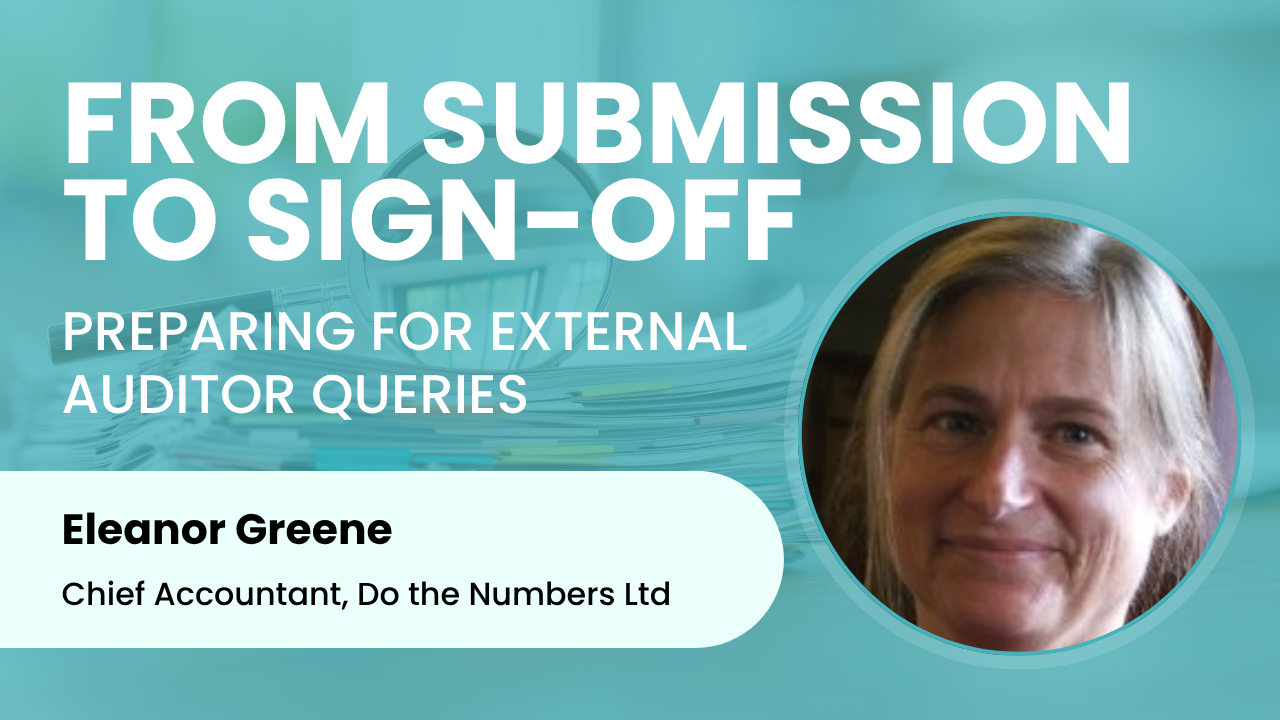
Hello everyone! I’m Eleanor Greene, Chief Accountant at Do the Numbers Ltd. I also serve as the Secretary for the Internal Auditors Forum and work closely with SLCC Hampshire. I’ve been auditing since 1997, and while I currently work with about 90 councils at any given time, my experience spans over 200 different authorities.
I recently had the pleasure of speaking at a Scribe Academy Webinar to discuss the post-AGAR submission window and navigating external auditor queries. My goal is to help clerks, RFOs, and councillors navigate the 2025/26 season with confidence, ensuring your council is not just compliant, but resilient.
The Reality of the Post-Submission Window
The theme of our session focused on that delicate period after you have hit send. Once you have submitted your Annual Governance and Accountability Returns (AGAR), you typically spend the next 3 months waiting in limbo for queries to drop into your inbox from the external auditors.
Let’s be completely honest: for those who have never been through this process before, it is stressful. For those who have been through it before, it is still stressful. There is simply no way around it because external auditors will inevitably send you a query using complex technical jargon, and your immediate reaction will be, "What on earth does this mean?" Understanding the framework they operate under is the first step to lowering that anxiety.
The External Audit Landscape
To understand why external auditors ask the questions they do, we must first look at how the entire system is structured nationally.
1. National Contracts and Sector Split
External audit contracts are issued in rigid five-year blocks, and we are currently in the fourth year of the current contract cycle. Nationally, the landscape is divided among four prominent accounting firms:
- PKF holds the contract for 31 counties.
- BDO holds the contract for 4 counties.
- Moors holds the contract for 5 counties.
- Mazars holds the contract for 4 counties.
The key thing to remember is that these appointments are decided at a national level; you have absolutely no control over which firm represents your county. Because each of these external auditors tests different elements and follows distinct internal processes, they will ask for different things. When a peer from a neighboring county tells you, "Oh, we've been asked to provide this specific document," check which external auditor they are with before you panic. You might be evaluated against an entirely different set of criteria.
2. The Role of the Joint Practitioners' Guide
While SAPPP Practitioners’ Guide 2026, published 31st March 2026, is not compulsory for the 25/26 financial year, Section 4 (which governs internal audit guidance) and Section 5 (the dedicated guidance for Clerks and Responsible Financial Officers) are incredibly useful right now.
This recent update was overseen by Mark Mulberry. Many of you will know Mark as an auditor, and he has done a truly fantastic job modernising it. I wrote the older version of this guidance, and I absolutely love his updates. If you are hit with a confusing query over the summer, please go back to Sections 4 and 5 of this guide to check what the latest guidance says. It will help you formulate your answers and align with the current direction of travel.
3. Sector Statistics and the Reality of Qualification
To give you some broader context on how our sector performs, consider these key statistics from recent audit cycles:
Audit Metric - Sector Percentage
Councils too small to require an external audit - 41%
AGARs approved and sent by the 30th of June - 76%
Councils receiving a qualified audit report - 33%
There may well be people reading this who manage both a large council and a tiny council, so you know how lovely it is when a smaller authority qualifies for an exemption and avoids the external process altogether.
For the larger ones, remember that while 76% of AGARs were with the auditors by the end of June last year, the statutory rule is that they must be approved by the council by the 30th of June with the default submission deadline the 1st July. If there is an "exceptional need", your external auditor may be able to extend submission deadlines by a maximum of four weeks to 31 July 2026.
The most staggering figure here is that 33% of councils received a qualified audit. In accountancy terms, qualified is not a good thing. A qualified audit essentially means "Yes, your accounts are fine, but you failed to follow a specific regulation or standard." If your council fell into that unlucky third last year, you must make sure you have thoroughly read, understood, and addressed exactly what went wrong.
4. Rigid National Fee Scales
The fee scales for external auditors are set rigidly by a national body, and the individual firms have absolutely no leeway.
As an internal auditor, I can be flexible. Many internal auditors operate this way: we charge some people a bit more and some a bit less depending on workload. If you are a council that has suddenly received a massive Community Infrastructure Levy (CIL) receipt, I might choose not to bump you up to a massive internal fee banding.
External auditors do not have that power. They are legally bound to look strictly at your turnover band. If your council goes even £1 over an audit band threshold, they are mandated to charge you the higher fee. Please do not get grumpy at your external auditor if an unexpected influx of CIL money pushes your turnover above £200,000. They literally have no choice, and their files are heavily scrutinised to ensure compliance.
The real sting happens when you receive a large developer grant or CIL receipt in year one, and then you spend that money on a major community project in year two. Because of how turnover is calculated, you will end up with two consecutive years of artificially inflated turnover, resulting in two very high external audit bills. It is frustrating, but it is simply the way the system is built.
The Danger of Turnover Miscalculation and "Netting Off"
When calculating your turnover to determine your audit band, you must understand exactly what constitutes income. While expenditure is generally straightforward, income includes absolutely everything: the precept, CIL receipts, Section 106 agreements, grants, donations, bank interest, and asset dividends.
A critical error that many councils make is attempting to "net stuff off" in their accounts.
Example: Imagine your council receives a specific grant of £4,000 to buy a new speed indicator device, and you subsequently spend exactly £4,000 to purchase that equipment. You are not allowed to cross those two figures off against each other to show a net zero effect on your AGAR.
The £4,000 must be recorded fully under income, and the £4,000 must be recorded fully under expenditure.
Furthermore, please do not attempt to hide developer funding or localised grants from your auditors. There is a transparent, public national database tracking exactly how much CIL and Section 106 funding every single local authority receives. If an external auditor discovers that a council has omitted these figures on their AGAR, it will go very badly for you. You will not only be hit with a hefty additional restating fee, but you will likely trigger a Public Interest Report.
While there is no direct financial sanction tied to a Public Interest Report, it is a matter of public record. The local press will find it, report on it, and you really do not want your council in that spotlight. Ensure your figures are complete, correct, and completely free of netted-off items.
Demystifying Auditor Powers
External auditors carry out their duties using a specific regulatory document known as AGN02 (Audit Guidance Note 02).
It is a completely transparent document that explicitly tells the external auditors exactly what they must ask for, as well as what they may ask for. What they may ask for is, frankly, whatever they deem necessary to satisfy their professional curiosity, and they have the full legal duty and power to demand it.
These firms are scrutinised heavily by the National Audit Office (NAO). They cannot simply decide to go easy on your council because you've had a tough year; they are bound by strict professional frameworks. The four contracted firms are nationally recognised, highly specialised organisations. They genuinely understand public sector accounting standards better than your local councillors do. Out of only about 25 accounting firms in the entire country licensed to perform public sector audits, only seven or eight even applied for this contract, and only four were selected. This is highly specialist work.
With that caveat in mind, sometimes auditors do ask genuinely silly questions. I was recently talking to a clerk from a brand-new town council who was asked by her external auditor why she hadn't filled in the comparative figures for the previous financial year! If your auditor has the gall to ask why a brand-new council has no figures for last year, simply send them a polite link to the official press release announcing your council’s creation.
Tips When Completing the Form
To ensure your council sails through the summer checking window smoothly, implement these systematic processes immediately:
- Enforce Cross-Form Consistency: Consistent responses across your paperwork are the easiest way to avoid triggering an auditor's automated flags. If your internal auditor has ticked No to a specific test on their page, you must ensure you tick No to the corresponding governance statement on your section of the form. Never guess. Ensure your internal auditor has completed and signed their page before the council finalises its statements.
- Leave No Blank Spaces: This drives external auditors completely mad. You must explicitly tick Yes or No on every single line of the form. For Section 1 (the Annual Governance Statement), these assertions apply to every single authority regardless of size. There is absolutely no council in England or Wales that can write Not Applicable on any line in Section 1.
Managing the Public Rights Window and the Summer Recess
For Exempt Councils
If your council is small enough to claim an exemption from a full external audit, remember that you are only exempt from the external review itself. Every other piece of legislation in the SAPPP Practitioners' Guide and the AGAR form remains completely mandatory. You must still secure proper internal audit sign-off, formally approve Sections 1 and 2 in council, publish your figures on a public noticeboard, and strictly observe the statutory public rights period. Your website must be kept fully up to date to comply with the Transparency Code and the Freedom of Information Act.
Navigating Public Rights
When I started auditing back in 1997, long before the advent of council websites, the Exercise of Public Rights was the absolute cornerstone of local democracy. Minutes were handwritten in ledgers and weren't published anywhere, so the public rights window was the only opportunity for a parishioner to see how their money was being spent.
Since the transparency code and modern websites came along, the physical inspection window feels like a bit of an administrative drag. However, it remains a statutory right. A member of the public is legally entitled to look at your original invoices, and they are allowed to take photos of them on their smartphones or ask you for copies.
You must ensure you display your notice for the full 30 working days, and it must encompass the nationally set core dates. All external auditors provide clear, downloadable templates for these dates—make sure you use them. If your auditor raised an issue with your public rights period last year, you must explicitly tick No to that governance box this year.
Nowadays, the individuals who turn up demanding to see physical stacks of documents under public rights are often highly critical, vexatious, or occasionally ex-councillors and ex-chairmen who have an axe to grind. It can be a tense experience, but you must remain systematic, polite, and legally compliant.
For Councils in Summer Recess
If you receive a complex auditor query during August when you are trying to take a well-deserved holiday, do not ignore it. Silence will only escalate the query into a formal breakdown of governance.
Instead, send a polite, formal holding reply explaining exactly when you will return to the office and when they can expect a comprehensive answer. Make your out-of-office automated email response work hard for you. Do not just say, "I am away until late August." Structure your automated response to say: "The council is currently in recess. You can find our full financial accounts published here [link], our public rights notice here [link], and if this is an urgent matter of external audit compliance, please contact our Chairman directly at [email]." If an auditor sends a query, receives a highly informative out-of-office response like that, and still chooses to complain about a delay, you hold the moral high ground. But please, give them that courtesy, because while you are enjoying your summer break, those audit teams are stuck in their offices working flat out through August and September to hit their deadlines.
Cracking the Code on Variances and Assertion 10
Master Your Variances
We all love a variance analysis, don't we? If you are audited by BDO, they supply a brilliant template spreadsheet where you input your AGAR figures and it automatically highlights fields in bright red and green to show exactly where your figures have deviated by more than 15%.
When drafting your variance explanations for any auditor, start with your absolute biggest financial variance first and work your way down the page until you have explained the fluctuations down to a margin of £500 or 15% (whichever is greater).
Be highly specific. Auditors do not want to see a vague note saying, "Wages went up." They know wages went up! They want to know why they went up. For instance, across almost every council of a certain size this season, national changes to employers' National Insurance alone have driven an automatic 9% increase in staffing costs. Combined with the NJC salary increments and pension contributions, most councils have seen a hefty uplift in staffing costs driven purely by contractual obligations. Tell them that.
If you bought equipment, write: "We purchased three public benches for £1,750." Don't forget to explain the things you didn't buy this year that you did buy last year. If you spent £20,000 upgrading a playground last year but only bought a £1,500 defibrillator this year, that drop is your variance. Start big, be precise, and if they ask for more detail, tear up your vague first draft and give them exact numbers.
Demystifying Assertion 10
This brings us to the new kid on the block: Assertion 10. Take a deep breath—it is going to be okay. Because this is the very first year that Assertion 10 has been formally introduced onto the AGAR form, the external auditors have made it very clear publicly that they are not going to come down incredibly heavy on councils this season. They know everyone is panicking.
To see exactly what they are looking for, look at the internal audit testing schedule inside the new 2026 Practitioners' Guide. The test is fundamentally about digital resilience and transparency. They are looking at basic, low-hanging fruit:
- Council-Owned Digital Infrastructure: Do you have a website that the council actually owns and controls? Or is your site still sitting on a vague community domain like chartumvillage.org that is actually managed by the local church? If a councillor runs your website on their personal account and suddenly resigns, the council loses its entire digital presence. It must be under officer control.
- Role-Based Generic Emails: Do you use a generic, official email address like clerk@towncouncil.gov.uk? This is vital for continuity. If a clerk leaves, that email address, along with its entire correspondence history with banks, insurers, and auditors, stays with the council corporate entity forever.
- Data and IT Policies: Can you point to a minute in your council records showing where you formally adopted a Data and IT Policy? Paragraph 5.122 of the Practitioners’ Guide contains a link to a model policy that is only four pages long. If your council hasn't adopted it yet, put it on your next agenda.
- Website Accessibility Compliance: When did your council last run an accessibility check over its website? Do not panic about being prosecuted. The Equality and Human Rights Commission (EHRC) is the enforcement body for web accessibility, and they operate purely on a reactive complaint basis. Since 2023, they have taken zero enforcement actions against parish councils. The government data office explicitly states that for the smallest public bodies—where running complex coding audits would represent a disproportionate burden—simply having a clear accessibility statement published in the footer of your homepage is sufficient compliance.
If your internal auditor has flag-checked your website and given you a negative management report on these points, you must tick No on your governance statement. Be consistent, don't try to paper over the cracks, and focus on making your council digitally resilient for the community you serve.
In Conclusion
At the end of the day, all of these compliance hurdles exist to serve our communities. Transparency builds trust. When we keep our financial governance tight, stable, and completely open to scrutiny, we protect the integrity of local government.
Take a deep breath, lean on your local CALC or the SLCC if you get an unexpected query that doesn't make sense, and remember that you are part of a massive network of officers navigating the exact same summer window.
Webinar Playback
Access the on-demand recording and slides.