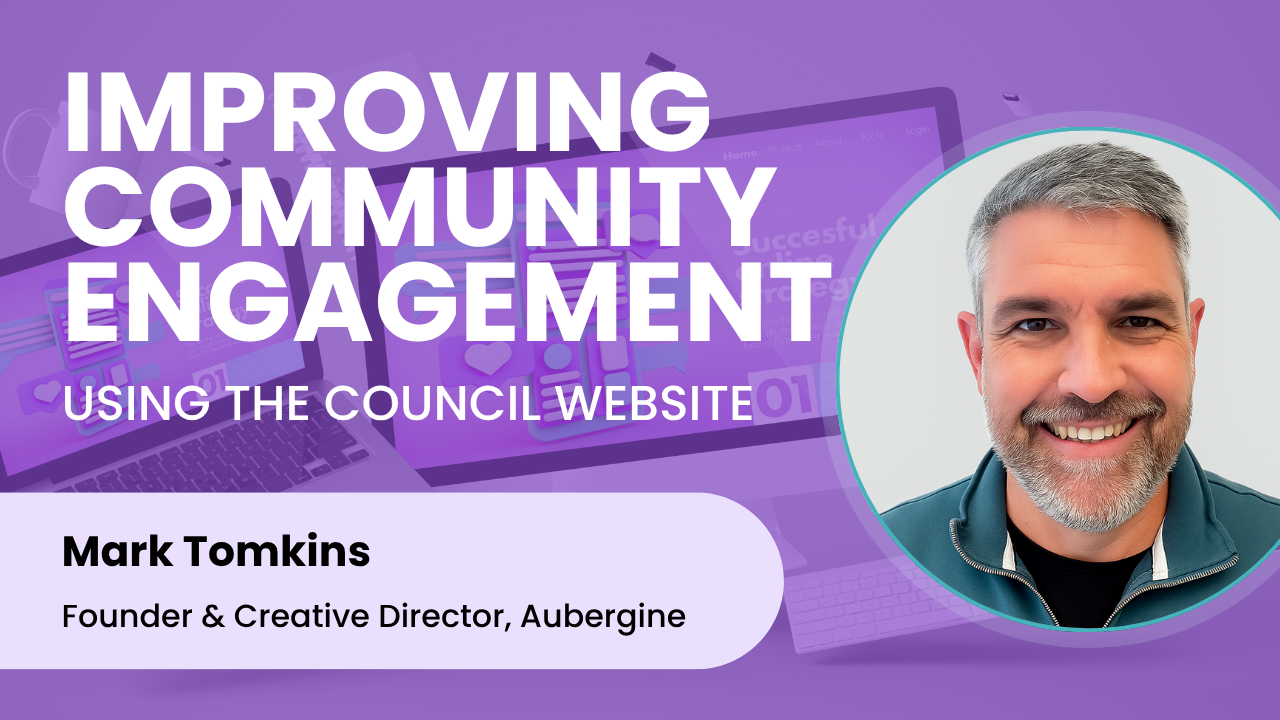
Improving Community Engagement & Getting the Best From Your Council's Website
Hello everyone! I'm Mark Tomkins, Creative Director and Founder at Aubergine - leaders in providing accessible and compliant websites and .gov.uk services to parish, town and community councils.
I’ve been an active parish councillor for nearly 15 years, and I also took my ILCA last year, too as did my business partner, Matt here at Aubergine. This dual perspective allows me to see both the strategic goals of a council and the practical, day-to-day challenges of managing information.
I recently had the pleasure of joining the Scribe Academy to talk about how to use your council website as a powerful tool for community engagement, and I have summarised the key takeaways below.
The Engagement Gap: Why Your Website Matters
For most councils, the website is seen as a place to dump minutes and agendas because the law says we must. But your website is actually the best communication tool at your fingertips. It has the widest reach and allows you to say the most to the most people in one centralised place.
The challenge is that parishioners often don't know the difference between a parish, district, and county council. By moving beyond compliance, your website can bridge this gap, serving as a hub that doesn't just list rules, but actually serves the "customer"—your community.
1. The Art of Helpful Signposting
Web professionals use the term signposting to describe how we direct users to the information they need. For a council, this is about serving your community even when the service they need isn't yours.
- The "Six Button" Strategy: Identify the six most common reasons people contact you (e.g., potholes, missed bins, planning).
- Direct Action Links: Create large, obvious buttons on your homepage that link directly to the principal authority’s reporting pages.
- Dynamic Updates: You can change these buttons seasonally—for example, adding "Salt Bin Reporting" during a harsh winter.
2. Interactive Feedback and Consultations
Engagement is a two-way street. If you want to know what the community thinks, you have to ask them in a way that is easy to access.
- Low-Level, High-Impact Polls: Use your website to host simple polls. Whether it’s a £3,000 project to replace village gates or a new playground design, giving people a "Choice A or B" option drives massive engagement.
- Data Control: When people provide feedback on your website, you own that data. You can analyse it and use it to inform your precept and budget planning. But remember to look after it and use it in accordance with both UK GDPR and your own data policies!
- Be Brave with Numbers: When reporting results, use actual numbers rather than percentages. If seven people respond out of a village of 1,000, "7 people" is more transparent than "0.7%," which most may struggle to contextualise anyway – 0.7% of what – the village, town or the amount of people who responded? Many folk can’t properly visualise percentage figures – but they can actual numbers.
3. The "Whole Truth" Zone vs. Social Media
Social media is where everyone hangs out, but it is the "Wild West"—unregulated and often full of keyboard warriors. Your website is your official zone of trust.
- The "Tease and Link" Method: Use Facebook to share a headline and a short excerpt (a "teaser"), then provide a link directly back to the full story on your website. Over time, this will build trust and your community will learn to go straight to your website.
- Outbound Communication: You should consider making the council's official Facebook page outbound only if you are short on time and resource to respond and react to comments on your posts – it avoid thing spiraling out of control for days until you get around to checking the comments. By turning the comments off it helps to avoid the management headache of offensive or inaccurate posts. But understandably, this is not the greatest if you are looking for some real-time engagement.
- The Power of Repetition: Most people only scroll social media for five minutes in a habitual way each day. To reach everyone, you should post the same post with link two or three times at different times of the day (morning, afternoon, and late night) across a week to catch different people and demographics.
- Evergreen content: This is information and content that you can post up a few times over weeks or months – reminder content that signposts the community to specific things – such as where to report potholes, broken streetlights or other community-wide issues and direct them to the right page on the principal authority’s website.
- Regular updates: The council will be doing good stuff all the time – but is almost certainly not telling the community to who they serve, about those things. Councils need to use both the website and social channels to share these ‘quick wins’ – sharing news that you have fixed the broken dog bin, installed a new rubbish bin outside the shop or that the grass verges are getting cut are all reminders to parishioners that the council is quietly getting on with helping the community – this is evergreen content that you can have as pages on the website that you link to from a short social media post.
4. Modernising Data Collection
The era of the downloadable Word or PDF form is over. If you want engagement, you must remove the barriers.
- No More PDFs: You cannot fill in a PDF or a Word document online. Expecting a resident to download, print, and mail a form is a massive barrier.
- Mobile-Optimised Web Forms: Over 85% of your visitors are using a phone, often at 9:40 in the evening while sat on the sofa. Your forms—whether for allotment applications or cemetery plaques—must be actual web forms that work on a mobile screen.
Practical Strategies for Council Officers
To implement these changes without doubling your workload, I recommend the following:
- The "Chair’s Update": Ask your Chair to write a short monthly news post. It could be about positive wins (like a new bin outside a shop) or challenges (like fly-tipping).
- Audit Your Forms: Test your contact forms on both a desktop and a mobile phone. If the "captcha" is broken, you are missing vital community feedback.
- Use Licensed Images or photos you own only: Never take images from Google or an unknown source. You expose the council to licensing fines. Use your own photos or those from a legitimate image library – Unsplash, Pixaby are a good start.
- Mega-Nav Navigation: If your website allows it, use "Mega Navs" to columnise content. Group all "Council Responsibilities" on one side and "Principal Authority Links" on the other.
Scenario-Based Guidance
For Councils with High Social Media Conflict
Switch to Outbound-Only. Use your page to push information out, but direct all "engagement" to a web form on your site. This encourages residents to be considered and concise in their feedback rather than firing off a reactive comment on a social post.
For Councils Lacking Content
Look at Your Minutes. Every positive decision—trimming a hedge, replacing a gate, winning a Green Flag award—is a "success story." Parishioners won't read the formal minutes, but they will read a short, friendly blog post about those same decisions.
Key Takeaways
- Mobile First: Over 80% of your audience is on a phone. If it doesn't work on mobile, it doesn't work.
- The Website is the Truth: Always drive social media users back to your site for the "whole story." – it’s the single point of truth that you control.
- Stop the Paper Trail: Replace Word and PDF forms with accessible web forms to increase submission rates.
- Consistency is Key: Post links at multiple times of the day to catch different audience segments.
Conclusion
Building transparency and trust starts with telling people what you are doing. We are often shockingly bad at sharing our successes If you (as a council) don’t tell the community what you do, the community will assume you don’t do anything. By using your website as a hub for news, helpful signposting, and easy-to-use forms, you empower your community to engage with you in a meaningful, manageable way.
Webinar Playback
Access the on-demand recording and slides.
Useful Resources
- Compliant website packages from £499+VAT
- Tutorials & helpful guides
- WAVE by Webaim accessibility page checker
- NALC Website Accessibility & Publishing Guidebook
- PDF accessibility checker
Mark Tomkins, Aubergine
Aubergine provides .gov.uk compliant, accessible website packages for parish and town councils starting from £499+VAT. We specialise in making digital compliance easy for clerks and councillors.
Contact Mark Tomkins:
- Email: thestudio@aubergine262.com
- Website: www.aubergine262.com