I didn't plan a career in local government. After ten years as a PA at P&O, and some work in the medical sector and in accounts, I took a job as clerk to a small parish council because it fitted around bringing up my children. It was a baptism of fire. The council didn't have up-to-date standing orders or financial regulations, and there were three years' worth of unaudited accounts waiting for me. Twenty years later, I'm Town Clerk at Stotfold Town Council in Bedfordshire. I gained my degree in my fifties, and I'm now studying for an MA in Public Leadership.
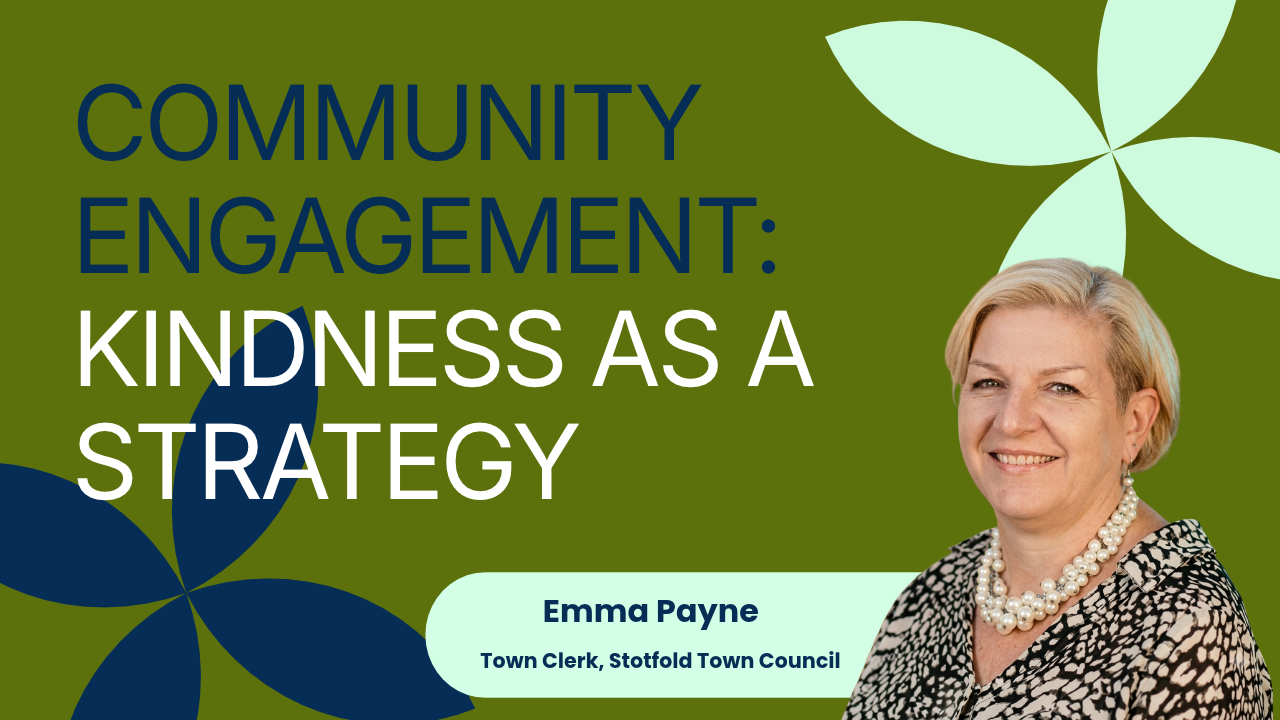
Recently, I had the pleasure of speaking at a Scribe Academy webinar about something I've come to believe in over the last five years or so: that kindness is a strategy, not a nice-to-have. If you'd asked me five or ten years ago, I wouldn't have given that talk. But as our careers develop, we start to look at things differently. I think we can be far too adversarial, in politics generally and sometimes in local government too, and I would like to stand up and be counted as a kind person.
In 2022, one in five residents were satisfied with the town council. Today, that’s more than half. This post follows on from that live session. It sets out what we changed at Stotfold, what happened as a result, and what I'd suggest to any clerk, RFO or councillor who wants to build more trust with their community.
Kindness Is Not the Soft Option
The most common mistake I see is people thinking that being kind means being soft. Kindness tends to get dropped when we're busy, or when we're trying to avoid a hard conversation.
But kindness done properly is clear, consistent and deliberate. It can also be an efficient use of resources.
1. We Were Right, but It Didn't Build Trust
We've all got potholes, and we've all got residents asking why the council isn't fixing them.
For a long time, our answer at Stotfold was the standard one: it's not our responsibility, it's the principal authority's, report it on FixMyStreet. That was accurate. But it didn't build trust. We were right, but that didn't mean our residents were getting the level of service a town council should be thinking about.
As town and parish councils, we're hyper-local, and that makes us an easy target:
- We're visible. Our offices are in the community centre, open Monday to Friday, nine to five, and the library is in the same building. People wander into the library and then wander in to see us.
- We pick up the phone. How many principal authorities still have a number you can ring and speak to a real person? Too often you reach a customer service team who promise to pass a message on.
- Residents expect an instant response. In this day and age, "we'll pass it on" just doesn't cut it.
About three years ago, I decided we needed to look at social media criticism from a different perspective. Depending on the platform, those conversations could be difficult and confrontational. But why not put ourselves in our residents' shoes? What were they struggling to understand, and why did they keep coming back to us about potholes?
2. Event + Reaction = Outcome
The idea that changed our approach comes from Paul McGee, the "SUMO" guy (Shut Up and Move On, or, in the version he does for children, Stop, Understand and Move On).
Every interaction with a resident is an event: a complaint about a pothole, a decision the council has made, a piece of difficult news we have to deliver. We can't control the event. But we can control our reaction, and the reaction shapes the outcome: how the resident receives the message.
- The old reaction: "It's not our responsibility. Report it to the principal authority." The outcome was annoyance, and the resident came back again, or took it to social media.
- The new reaction: "Thank you for telling us. This is really frustrating. What can we do about it?" We'd ask whether they had reported it on FixMyStreet and for the reference number, so we could follow it up. We also set up a pothole Facebook group, so residents could log the problems, and we could monitor how many people were affected.
- The new outcome: "The town council is listening to us." Understanding increased, and trust was protected.
A kind, honest and practical reaction doesn't guarantee a good outcome. But it makes a good one far more likely.
I know a larger town council has more capacity to do this than a small parish with very limited resources. But I think most councils could find their own version of it.
3. When Residents Become Your Advocates
It was a very boring lesson to have to deliver, time and time again. Then, suddenly, something changed.
Residents began answering each other's questions before we could reply. Someone would post, "Why are there potholes on the high street?" and a resident would answer: "It's not the town council's responsibility. That's the principal authority. Report it on FixMyStreet."
Our residents had become our advocates. The message had filtered through, it was being received, and those residents were now our champions. That was a lovely moment. It showed us we were actually making a difference.
4. Delivering Bad News: The Skate Park
Sometimes you have to deliver bad news, and the way you do it matters just as much.
Before I started at Stotfold, the council had decided to build a skate park in the park where our offices are based: a project of around £330,000. We had an earmarked reserve of about £100,000 towards it, and the plan was to fund the rest from Section 106 money.
We're fortunate to hold around £1.5 million of Section 106 funding for our play areas, parks and community centre, handed over by developers. Unusually, because the agreements cover ongoing maintenance, we received the money in advance, and it sits in the bank earning interest. The proposal was to borrow from it to build the skate park and repay it later, from the sale of a building or through the precept, a bit like a Public Works Loan.
I had to say no. That money is specifically for maintaining those sites, and you can't borrow it for something else. A colleague of mine says it's better to ask for advice at the top of a cliff than for an ambulance at the bottom, and this was a case of not having done the due diligence on what the Section 106 agreement really allowed.
So I followed three steps:
- Lead with the news. No, we can't borrow the Section 106 money.
- Explain why. It's ring-fenced for maintenance, so we must use it for that purpose. I also explained the risk: an objection to the accounts could lead to an examination by the external auditor, costing thousands of pounds, and a report to the principal authority that we weren't using our Section 106 properly.
- Come with a solution. I spoke to our internal auditor, who confirmed the position and talked me through the alternatives. We looked at our finances and our reserves, and I was able to put forward another way to fund the project.
It wasn't a palatable answer, but members understood it. I was trying to be kind, but I had to be firm at the same time.
5. Kindness Without Boundaries Is Just Exhaustion
This leads to the point I most want people to take away: kindness is not the same as soft. Kindness without boundaries is not kindness. It's just exhaustion.
We've all answered emails at nine o'clock at night and been on the end of the phone when we should have stopped. But you don't serve anybody if you don't put boundaries in place. I think about boundaries in three ways:
- What is ours. Be clear about the council's responsibilities and its limits, as we did with residents over potholes, and then give people a solution. They come to trust you to give them an honest answer.
- What is allowed. Be polite when you have to say no, and stay polite when that no is challenged. A polite no remains a no.
- What behaviour is acceptable. Be generous with anger, because people are often passionate about their community. But be firm with threats.
Being kind to yourself, and your staff
In a previous role, a 5G mast went up on the high street, and I received an angry voicemail about it at the office. We all know that our powers on planning matters are very limited, especially where utilities and telecoms are concerned. But this person felt very strongly, so I let the first voicemail lie.
I couldn't let the second one lie, because it contained a threat. In that instance, the kindest thing I could do was be kind to myself, by not accepting a verbally abusive, threatening message. It was also kindness to my staff, who live in the parish and felt threatened too. I reported it to the police, and the person was interviewed under caution for malicious communications.
You can be kind and still say no. You can be kind and still say stop.
6. Kindness as a Strategy: Start With What's Already Strong
Kindness isn't just a value. As a strategy, it enables you to develop your community. It sits within asset-based community development, an approach championed by Cormac Russell, and it's about empowering your community rather than simply engaging with it.
Cormac tells the story of a vicar whose bishop told him he had to start a food bank to serve those in need. The vicar's response was: why, when there are already organisations out there doing that?
So start by identifying the assets your community already has:
- Your councillors, who often sit on other local groups.
- Food banks, church groups, youth groups and volunteers.
- Local knowledge and practical experience.
- Residents who already help themselves and help others, like the residents who now explain to others on social media that the town council doesn't fix potholes.
Assume everybody is working with the best intentions for their community, and invite people in.
7. Measure the Change, Not Just the Comments
It's really hard to show you're winning hearts and minds if you can't measure it. I was fortunate to take on a residents' survey when I joined Stotfold three years ago.
- How we run it: the survey goes out in early January for about six weeks, online and on paper.
- Response: around 9,500 people live in Stotfold, and we get about 600 responses.
- The baseline: in 2022, the proportion of residents who were satisfied or very satisfied with the town council's performance was, frankly, a bit pants: 20%.
- The latest result: 53%.
If you want to go down this route, I heartily recommend setting a baseline first, so you can see how you're doing for your residents.
Don't fear the feedback
If you're thinking about a first survey, don't be put off by the worry that residents will use it to complain about things the council doesn't control. There's no such thing as bad feedback. Treat it as feed-forward: it shows you exactly where residents don't understand who is responsible for what, and that tells you where to focus your communication. It took us a long time to get residents to understand what we were responsible for, but you've got to start somewhere.
You also don't have to go out to every resident at once. Think about the organisations already on your side. You'll probably have councillors who sit on the local church group or lead a scout group. Ask them to start conversations with those organisations, plant the seeds, and build from there.
8. Be Kind to Yourself
None of this works if you're running on empty. Be as kind to yourself as you are to your residents.
- Rest is part of the job. We're always thinking about what we have to do next, and we sneak in the odd email at nine o'clock at night or at the weekend. But you cannot work for your community, your loved ones or your family if you are exhausted.
- Ask for help early. I'm a member of the Society of Local Council Clerks (SLCC), my council pays for my membership, and my branch has always been there for me, from the day I started as a part-time parish clerk. Every SLCC branch has a mentor.
- Make the time, even if it's virtual. If you're a lone, part-time clerk, it's hard to find the hours for branch meetings, and some counties are huge. If your branch offers virtual meetings, take them up.
- Find your tribe. Sometimes it's just picking up the phone to a neighbouring clerk and saying, "I've had a dreadful day." They understand, because they've had the same calls about dog bins and potholes. Your county association can help too, although it often has more of a councillor focus.
Sustainable kindness includes you.
Key Takeaways for Clerks, RFOs and Councillors
- Change your reaction, not just your answer. Acknowledge the frustration, then explain who is responsible and what happens next.
- Be patient. Explaining the same thing again and again is how residents become your advocates.
- When the answer is no: lead with the news, explain why, and come with a solution if you can.
- Set boundaries: what's yours, what's allowed, and what behaviour is acceptable. Be generous with anger and firm with threats.
- Start with what's already strong. Identify the people and groups already serving your community and invite them in.
- Measure it. Set a baseline and survey residents regularly.
- Look after yourself. Rest, ask for help early and find your tribe.
Be Right, and Be Kind
You're going to have to deliver messages you'd rather not deliver. Say it straight, explain why, and tell people what happens next.
Not long ago, I had a resident in touch about a dog bin on one of our new developments that constantly overflows. A management company is supposed to empty it, and the council doesn't have the facilities to do it ourselves. So I told the resident how frustrating it must be, paying more in management fees each month than they pay towards the town council's precept, and that I would take it up with our principal authority, and report it to Environmental Health. I can go into bat for my residents like that because I have the capacity to do it.
You can't please everybody all of the time, and you have to give that disappointment room to exist. But you can be right, and you can also be right and kind.
Webinar Playback
Access the recording, slides and podcast
About the Author
Emma Payne is Town Clerk at Stotfold Town Council in Bedfordshire. She has been clerking for around 20 years, starting as a part-time parish clerk, after ten years as a PA at P&O. Emma holds a BA (Hons) in Business Innovation and Leadership from the University of Hertfordshire and is studying for an MA in Public Leadership through the SLCC and De Montfort University. She regularly shares what life as a town clerk involves on LinkedIn.
Stotfold Town Council serves a town of around 9,500 people on the Bedfordshire and Hertfordshire border, providing local services, parks, play areas and a community centre. For more information, visit https://www.stotfoldtowncouncil.gov.uk.