
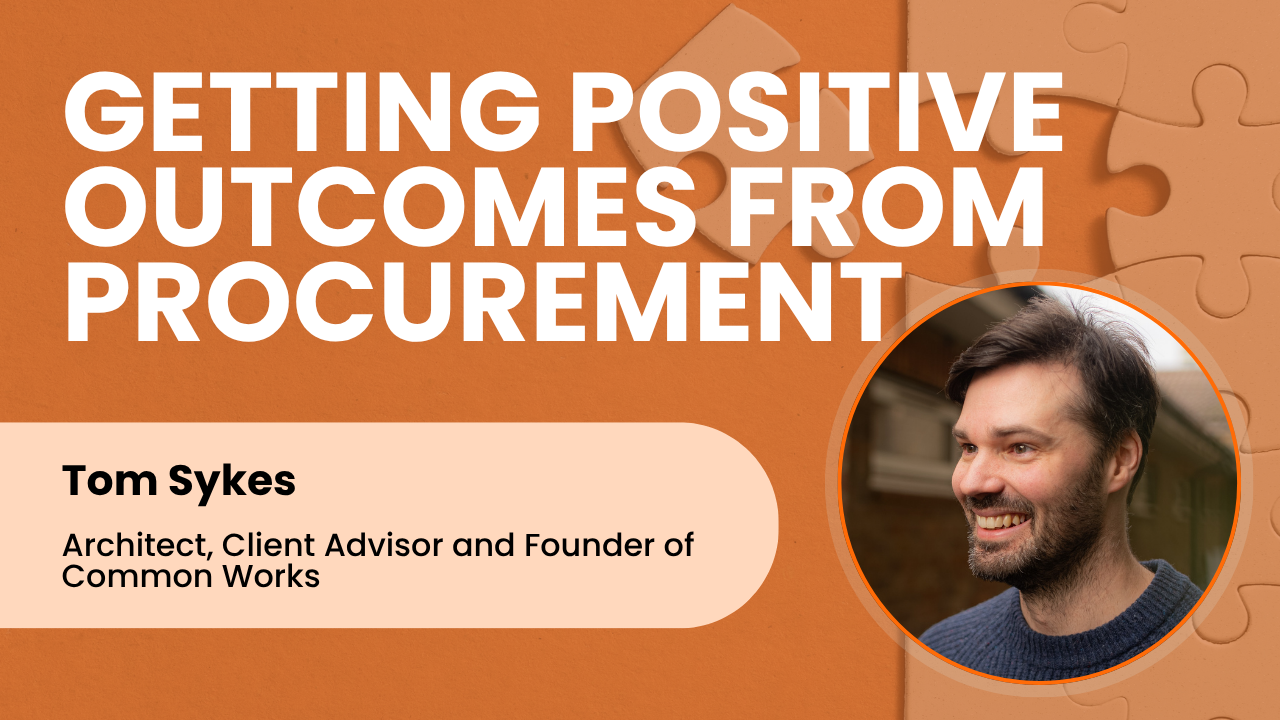
Hello everyone, I’m Tom Sykes. I am an architect and the founder of Common Works, an architecture practice dedicated to working with communities and public sector clients. My journey into the world of procurement isn't just about spreadsheets and contracts; it’s about people. Before founding Common Works, I served as the Head of Design for Transport for London’s (TfL) property team, overseeing housing and mixed-use schemes across 5,000 hectares of land.
When I arrived at TfL, I found a culture where cost was king, often at the expense of quality and long-term community value. I spent four years shifting that culture—setting design principles, sustainability standards, and community engagement tools. It was a serious undertaking, but it taught me that good stewardship in the public sector is about looking at what a place will be like in 25 years, not just the deal in front of us today.
I was thrilled when Scribe Academy asked me to share these insights with you. Whether you are a clerk, an RFO, or a councillor, you are in a position of awesome power. You are the stewards of your community’s assets. Procurement is the first substantial stage of a professional relationship between your council and an organisation. It is, at its heart, about relationships.
The Topic Foundation: Why Procurement Matters
For parish and town councils, procurement is often viewed as a boring administrative hurdle. But jargon aside, procurement is the tool you use to get the right thing for your team, your councillors, and—most importantly—your communities.
When we talk about value, it’s often shorthand for cheaper. But think about furnishing a community space. Do you want the budget chair that looks nice but breaks in a year, or the mid-range chair with a warranty that is actually comfy and welcoming? We all face the risk of ending up with the lower-quality option, but I want to help you secure the quality your community deserves. Better procurement leads to better outcomes, saving you time, money, and heartache in the long run.
Core Framework: Setting the Stage for Success
To move beyond the lowest price trap, we must adopt a framework focused on proportionality and quality.
1. Understanding Thresholds and Proportionality
Every council has standing orders and financial requirements. While the national Procurement Act 2023 sets high thresholds (e.g., £215,000 for services), your local rules might be much tighter. I’ve seen councils require three quotes for anything over £500. This is a massive administrative burden for a clerk and a deterrent for small local suppliers who can’t afford to spend a day's work on a tiny quote. Proportionality is key; your process should match the scale of the risk and the value of the project.
2. Finding the Right Partners
There are three main ways to find suppliers, and each has its place:
- Frameworks: These are pre-curated lists. They offer red tape protection and the procurement process is mapped out for you, but they can exclude smaller, local, or more creative firms that can't afford the administrative cost of joining.
- Contract Finder: This involves casting a wide net. While transparent, you have no idea who will read the tender or how they will respond.
- Curated Shortlists: This is my preferred route. It involves building a list of suppliers you know are skilled and inviting them to tender. This work makes you a better client because it forces you to get to know the market.
3. The Power of Methodology-Led Questions
Instead of asking for a finished design (which is often rushed and non-collaborative), ask for a methodology. Ask the supplier: "How will you solve our problem? What are the risks you see?" This allows the best team to shine, rather than just the one that produced the flashiest "beauty contest" entry.
Detailed Breakdown: Crafting the Perfect Brief
The Hierarchy of Information A common mistake is providing too many documents with conflicting information. You must integrate this information yourself to ensure clarity. Start with a Project Brief that layers your requirements logically:
- Core Values: What makes your council tick? (e.g., climate targets, localism), what makes your council special? (e.g. your identity, your history).
- Specific Ambitions: What do you want to achieve socially and spatially?
- Deliverables: Clear, minimum outputs listed in one place only to avoid confusion.
Realistic Programming Unrealistic timelines put off the best suppliers. If a supplier feels they can't do the job properly in the time allotted, they may simply not bid. Instead of a binding deadline, provide an indicative date and ask suppliers to propose their own program. You then score them on the rigor and completeness of their plan, not just how fast they claim they can work.
Resource Charts and Value I am a huge advocate for the resource chart. This shows exactly how many hours every member of the team will spend on your project. In order to price a project accurately, we work out exactly who is doing what and for how long. If you compare a cheap fee against a higher one, this chart usually proves that the "better" team is simply taking the time to do the job properly the first time, whereas the cheaper bid might be cutting corners on necessary research or engagement.
Practical Strategies for Council Officers
For clerks and RFOs managing these processes, I recommend these actionable steps to improve your next exercise:
- Test Your Brief: Before going live, send a skeleton brief to a friendly supplier and ask: "What information would you need to give me a competitive and clear tender?" Use their feedback to build out the final document.
- Use Deviation from Mean Scoring: Avoid lowest price scoring, which rewards under-pricing. Instead, find the average price of all bids. The closer a bid is to that average, the higher it scores. This identifies the outliers who either haven't understood the project or are being unrealistic.
- Set Strict Page Limits: To save your own sanity during evaluation, limit responses to two sides of A4 for text and four sides for graphics. If the original question isn't short and clear, rewrite the question rather than adding more clarifying notes.
- Provide an Excel Template: Don't let suppliers send fees in different formats. Provide a clear template so you can compare apples to apples across all bids.
Scenario-Based Guidance: Choosing Your Route
For Complex Consultancy (e.g., New Community Centers or Masterplans) Focus on Methodology (Route 2). You need a guide through a long, complex process. Look for teams that identify risks early—such as planning obstacles or funding gaps—and show a clear process for community engagement. In these cases, your involvement as a client is active and collaborative.
For Repeatable or Specialist Works (e.g., Installing a Lift or Specialist Engineering) Focus on Previous Experience (Route 3). If you know exactly what you want and you've seen a supplier do it before, ask for case studies. This is most appropriate for construction or technical engineering where the process is standard and the outcome is highly predictable.
For Councils seeking Social Value Be realistic about the scale of your project. If you want a supplier to provide social value—like training a community champion—make sure these elements are costed separately. Suppliers won't suggest "awesome" community ideas if it makes them look uncompetitive in a basic pricing section.
Key Takeaways for Parish and Town Councils
- Procurement is the Start, Not the End: It is the first step in a relationship that might last years. Choose the team, not just the price.
- Avoid the "Lowest Price" Trap: It is a false economy. A cheap fee usually means less time spent on your project.
- Transparency Leads to Better Bids: Tell people your budget. Let them compete on how much service they can provide for that sum, rather than how much they can undercut each other.
- Practice Scoring Yourself: Before the bids come back, practice answering your own questions. If you can't describe what a "good" answer looks like, the question needs work.
Conclusion
Procurement is a fascinating, interpersonal question: How do you set out your ambitions so that the right person can help you realise them? No matter your budget or the scale of your project, you and your community deserve great suppliers making great things for you. Be creative, be courageous, and remember that a well-run tender is the first step toward a project that will serve your community for decades.
Playback
- Watch the Recording
- Access the Slides
- Listen to the Podcast for a more personal chat about my background and my "secret" no one knows!
Common Works
Common Works is an architecture and design practice that helps councils transform assets into community hubs. We specialise in community buildings, housing, masterplanning and public realm projects that spark connection. We believe that every space should be designed with the community at its heart.
Contact: Tom Sykes | ts@common-works.co.uk | www.common-works.co.uk